

Print on Demand vs Dropshipping is a core decision for any modern ecommerce brand seeking scale and speed in today’s competitive marketplace, where every design choice can influence margins, shipping timelines, and brand perception. This introductory guide explains how each model shapes not only product quality and margins but also shipping accuracy, return handling, and the overall customer experience. By comparing design flexibility, branding potential, and fulfillment timelines, you can map your brand’s path to growth, identify potential bottlenecks, and forecast how changes in volume will affect operations. We’ll explore a concise POD vs dropshipping comparison that surfaces practical pros, cons, and how to test ideas with a small pilot, customer feedback loops, and clear success metrics. Ultimately, the discussion centers on ecommerce fulfillment models and what each option means for speed, cost, reliability, and customer satisfaction across different regions and market segments.
Viewed through an SEO lens, the broader concept maps to on-demand manufacturing, made-to-order products, and supplier-led fulfillment, all of which influence how you balance inventory risk with product customization. This POD vs dropshipping comparison highlights the trade-offs between customization, speed, and control, underscoring how brand promise, supplier reliability, and platform constraints shape performance. For brands evaluating options, the print on demand benefits and drawbacks guide helps balance design freedom with cost and logistics, from color accuracy to sizing and packaging. A practical path is to consider dropshipping for brands for items that benefit from breadth and faster market reach, while reserving core lines for branded, made-to-order items.
Print on Demand vs Dropshipping: Choosing the Right Fit for Your Brand
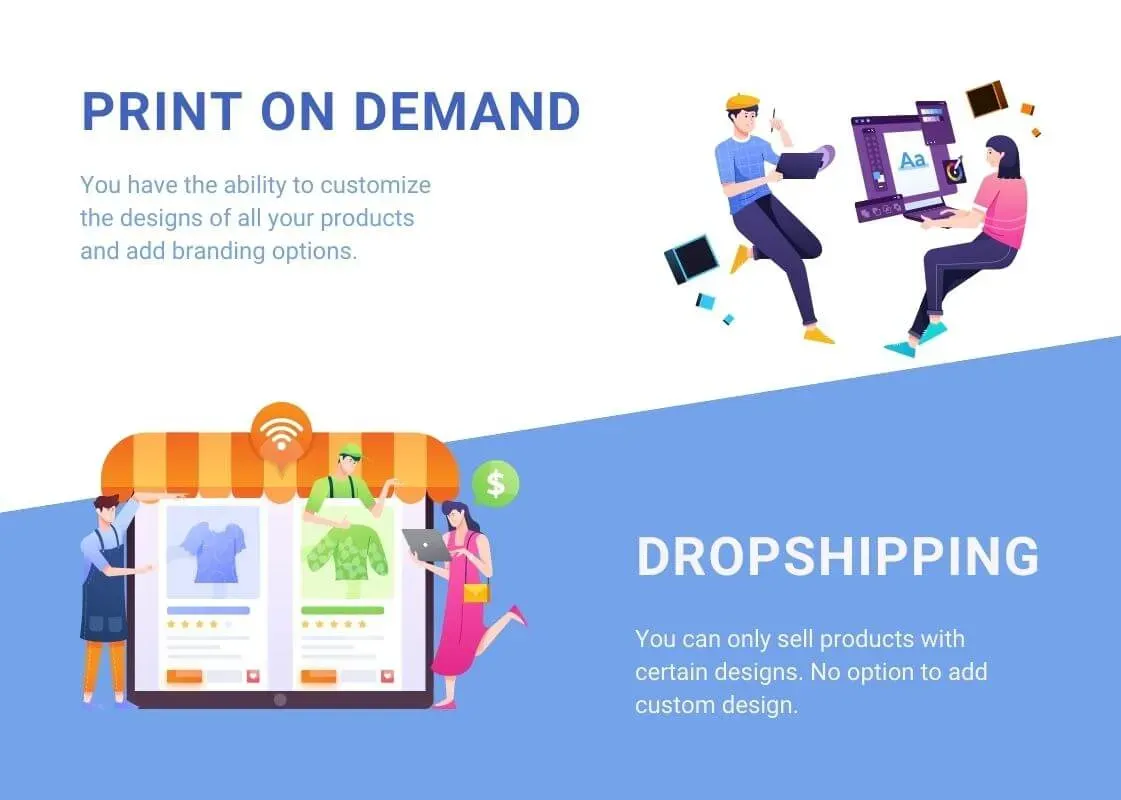
At a high level, POD and dropshipping are two distinct ecommerce fulfillment models that shape product quality, branding, and customer expectations. Print on Demand, or POD, focuses on designing products that are produced only after an order is placed, enabling strong brand storytelling through custom artwork, colors, and packaging. Dropshipping, by contrast, relies on suppliers who stock products and ship directly to customers, offering extensive catalogs and geographic reach with less upfront production risk. In a print on demand benefits and drawbacks assessment, you weigh customization potential against scale and supplier reliability, considering how each option impacts your margins, inventory strategy, and unboxing experience. The decision hinges on your brand promise and the speed at which you want to move from concept to customer.
To decide effectively, map your customer expectations against operational realities. POD excels when your value lies in unique designs and repeatable branding moments; you can launch limited editions without large inventory commitments and test new designs quickly. Dropshipping shines when breadth of products and rapid geographic expansion matter more than item-level customization, but you must manage supplier quality, packaging consistency, and delivery promises. A thoughtful approach often combines the two, using POD for core branded items and leveraging dropshipping for non-core or seasonal lines as part of a cohesive ecommerce fulfillment strategy.
Understanding Ecommerce Fulfillment Models: From POD to Dropshipping
Both POD and dropshipping are part of the broader category of ecommerce fulfillment models. POD centers on on-demand production and brand-aligned packaging, while dropshipping emphasizes a broad product catalog and outsourced logistics. When evaluating these options, consider how fulfillment speed, production complexity, and branding opportunities influence your customer experience. Clear alignment between your product strategy and fulfillment model helps you set realistic expectations around order velocity and post-purchase service, which is a key component of a sustainable online store.
Additionally, dropshipping for brands can unlock rapid catalog expansion with relatively low capital, but brands must invest in supplier scoring, packaging standards, and a consistent returns policy to protect brand equity. Dropshipping for brands emphasizes not just pricing but the quality of the customer journey, from product pages to delivery notifications, which is essential for long-term loyalty.
POD vs Dropshipping: Costs, Margins, and Brand Experience
From a cost and margin perspective, POD unit costs are often higher due to printing, materials, and production time, yet the value comes from strong branding and the ability to price for customization. In a POD vs Dropshipping comparison, these factors drive per-item profitability, the potential for premium positioning, and opportunities to test limited editions. Consider how printing methods, ink coverage, and final packaging influence perceived value and return rates.
Brand experience is also a differentiator. POD allows you to curate unboxing moments, color consistency, and quality standards that reinforce your story, while dropshipping can risk inconsistent product experiences across suppliers. Implementing robust supplier criteria, clear packaging standards, and a transparent returns policy helps maintain a premium feel even when using multiple fulfillment partners.
Hybrid Strategies: Balancing POD and Dropshipping for Growth
A hybrid approach blends the strengths of both models, aligning with many brands that need design-centric core products plus a broader shelf of items. This arrangement addresses the classic trade-off in the POD vs dropshipping spectrum: control and customization versus breadth and speed. By selecting a core line of branded POD products and layering in dropshipped items for discovery and seasonal demand, you can scale while preserving a cohesive brand narrative and reliable fulfillment.
To implement successfully, set clear governance around inventory visibility, branding guidelines, and customer service. Integrate order routing so customers experience a single checkout and consistent support, even when items come from different fulfillment streams. This is where ecommerce fulfillment models intersect with operations, and a well-planned hybrid strategy can protect margins while expanding market reach.
Decision Framework and Pilot Testing: How to Decide the Right Model
Use a structured decision framework to test POD, dropshipping, or a hybrid on a controlled scale. Start by defining your brand promise, identifying core products that benefit most from customization, and selecting a representative market to pilot. Measuring order speed, return rates, and customer feedback during a pilot helps you compare the real-world performance of each model against your KPIs in the context of ecommerce fulfillment models.
Key metrics to track include unit economics, shipping times, packaging quality, and post-purchase support load. Document the thresholds at which you would pivot from one model to another, and plan a staged rollout to minimize risk. Regardless of the model you choose, invest in branding, product photography, and clear product descriptions to support SEO and conversions, leveraging the related terms such as ‘print on demand benefits and drawbacks’ and ‘POD vs dropshipping comparison’ to improve discovery.
Frequently Asked Questions
Print on Demand vs Dropshipping: what is the fundamental difference between these ecommerce fulfillment models and which is better for a new brand?
Print on Demand vs Dropshipping are two ecommerce fulfillment models with distinct strengths. POD creates items only after order, enabling branding customization and consistent design, but with higher per-unit costs and longer production times. Dropshipping uses suppliers to stock and ship products, offering broader catalogs and lower upfront risk, but less control over quality, packaging, and branding. For a new brand, POD supports brand storytelling and premium positioning, while dropshipping helps test a wider range quickly. Many teams start with POD and scale with hybrid approaches as needed.
POD vs dropshipping comparison: how do branding, customization, and customer experience differ between these approaches?
In a POD vs dropshipping comparison, branding and customization sit at opposite ends of the spectrum. POD enables strong branding and customization because products are printed to order, supporting unique designs, limited editions, and cohesive packaging. Dropshipping offers broader product catalogs and faster discovery but often sacrifices branding consistency and packaging control. Customer experience can vary: POD orders emphasize unboxing and brand storytelling, while dropshipping success hinges on reliable supplier performance and clear expectations around shipping times.
What are the print on demand benefits and drawbacks for ecommerce stores?
Print on demand benefits and drawbacks largely define the decision between POD and other options. Benefits include low upfront investment, fast market testing of designs, and strong branding potential since items are produced to order. Drawbacks include higher per-unit costs, longer production times, limited product types, and potential variability in print quality. Returns can be more complex with custom items. To succeed, align pricing with value, request samples, and maintain transparent customer expectations.
Dropshipping for brands: when does it make sense to choose this over POD?
Dropshipping for brands often makes sense when breadth of catalog, rapid market entry, and lower upfront risk matter more than customization. It allows you to test many products, reach new regions, and scale quickly. However, branding and quality control can be challenging, so set clear supplier standards, packaging agreements, and returns policies. In many cases, a blended approach uses dropship for non-core items while core products stay POD.
When should you blend POD and dropshipping under the ecommerce fulfillment models framework?
This hybrid strategy is common. Start with POD for core branded products to protect margins and storytelling, and use dropshipping for non-core items to broaden catalog. Implement a unified brand experience: consistent product descriptions, packaging where possible, and cross-channel visibility. Run controlled pilots, track order metrics, and ensure customer service handles both fulfillment paths seamlessly. The takeaway: align your decision with brand promise and operational capabilities across ecommerce fulfillment models.
| Aspect | Print on Demand (POD) | Dropshipping |
|---|---|---|
| Definition | Products created to order; POD vendors handle printing, packaging, and shipping under your brand; no inventory. | Supplier stocks products and ships directly to customers; you source at wholesale and resell; no handling of products. |
| Brand control & customization | High customization and branding; limited runs; designs scale with orders. | Broad catalog but less control over manufacturing and packaging; branding depends on supplier materials. |
| Inventory & fulfillment | No warehousing; production-based fulfillment; longer per-item cycles during peaks. | Inventory managed by supplier; quick catalog expansion but risk of backorders if stock runs out. |
| Shipping speed & reliability | On-demand production; regional networks can be fast, but some regions face longer times. | Potentially faster with efficient hubs; risk of overseas transit delays. |
| Costs & margins | Higher per-item costs due to printing; premium pricing through customization; margins rely on design value. | Lower per-unit costs across many items; easier to price competitively but branding can erode premium if quality varies. |
| Quality control & returns | Consistent output; own designs; returns aligned with brand policy. | Quality varies by supplier; returns can be complex; need clear criteria. |
| Brand experience & packaging | Control packaging and unboxing; cohesive branding. | Packaging largely supplier-driven; white-label options exist but may be limited. |
| Scalability & risk management | Scales with design-driven growth; bottlenecks possible if vendor can’t keep pace. | Scales quickly in catalog size; higher supplier dependency risk. |
| Marketing implications & customer expectations | Supports branding-led campaigns; time-limited drops create urgency. | Enables breadth and geographic expansion; requires curation to avoid customer overwhelm. |
| When POD makes sense | Unique designs, strong branding, quick testing, premium packaging. | Not ideal for customization; can be used sparingly to support breadth. |
| When Dropshipping is a better fit | Limited or no customization; branding emphasis may be reduced. | Breadth of catalog, fast geographic reach, lower upfront risk; ensure quality via supplier agreements. |
| Hybrid approaches | Core branded POD items plus limited-edition designs. | Non-core items or seasonal collections; align to deliver a cohesive customer experience. |
Summary
Print on Demand vs Dropshipping is a strategic decision that shapes margins, branding, and growth trajectory for ecommerce brands. There is no one-size-fits-all answer: many successful businesses start with POD for branded, design-forward products and later blend in dropshipping to broaden catalog and reach. A thoughtful hybrid approach can deliver the best of both worlds—core, branded POD items alongside a curated dropship catalog to drive discovery and scale. To decide, clearly define your brand promise, map your product strategy, test supplier reliability, and run controlled pilots while investing in branding and content. The right model aligns with your goals, delivers a cohesive customer experience, and supports sustainable growth.